
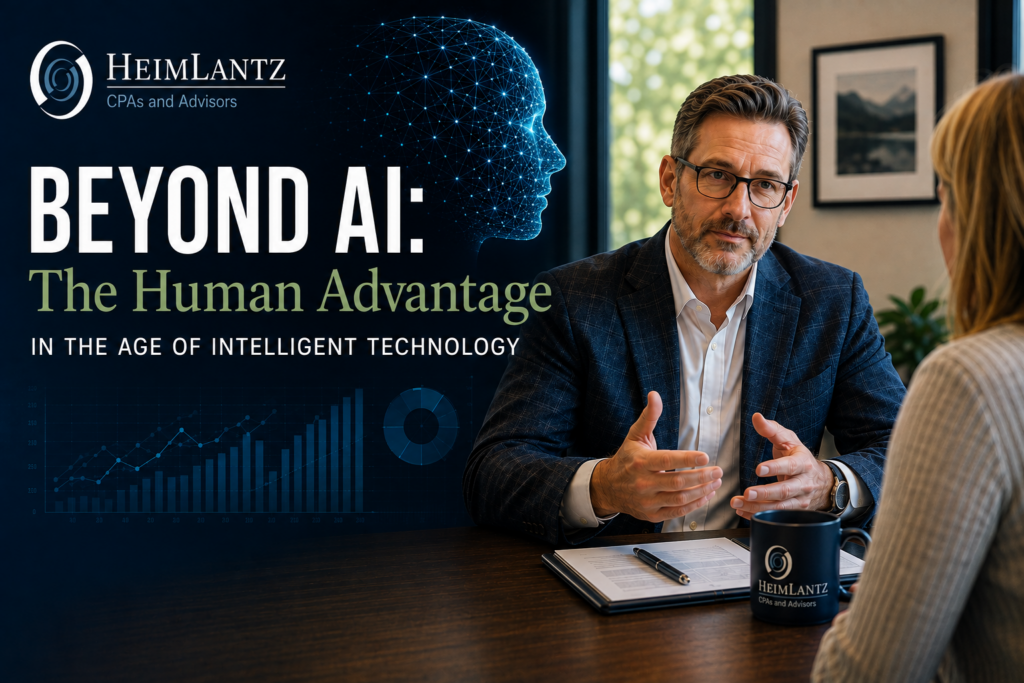
Why Human Judgment Matters More Than Ever in an AI-Driven World
By Dan Russell, Director of Business Development & Consulting Team Leader
I get asked a version of the same question almost every week, usually by a client on a Teams meeting: “Daniel, what should we be doing with AI?”
It’s a fair question. But after many years of sitting in on valuation engagements, succession planning conversations, and more than a few tense family business meetings, I’ve started to think it’s not quite the right one.
The better question is this: as AI gets more capable, what becomes more valuable about being human?
I’ve detailed a few thoughts below regarding possible answers to this question.
Everybody’s Getting the Same Toolbox
I perform business valuation and advisory work for closely held companies, mostly here in the DMV area. In the last couple of years, I’ve watched AI creep into nearly every corner of what we do, from pulling comparable transaction data faster, running sensitivity analyses in a fraction of the time, to drafting first passes at reports that used to eat up a full day. It’s genuinely useful and I’m not going to pretend otherwise.
But there’s a potentially scary reality beyond my own experience: everybody else doing what I do has access to the same tools. The construction company down the road, the manufacturer, the CPA firm across town are all going to be running on comparable AI capability within a few years. That’s just how it goes with every big technology shift. Cloud computing was a differentiator until it wasn’t. The same was true with mobile, and the same with the internet before that.
AI is headed in the same direction. It’ll stop being the edge and start being the entry fee. So, if the tools even out, what actually separates one firm or one advisor from another? The answer? People do. Not just smart people, but people who desire to grow and keep growing.
What AI Still Can’t Do at My Desk
I can ask an AI tool to run a DCF model or flag inconsistencies in a set of financials, and it’ll do it well. What it can’t do is sit with a business owner who just lost her father and is trying to figure out what his construction company is actually worth for estate purposes, while also grieving her loss. It can’t read the tension in a room when two siblings disagree about whether to sell the family business. It can’t tell me when a client is saying “I’m fine with the numbers” but clearly isn’t fine with something underneath them. That’s not a knock on the technology. It’s just not what it’s built for, unlike the humans that built it.
AI can process information. It can’t build the kind of trust that makes a business owner hand you their financial life and trust you’ll handle it right. It can spot patterns in the data. It can’t sense the things that never make it into a spreadsheet: the legacy, fear, pride, the weight of a name on a building, those factors that are all innately human.
The Work Gets Harder to Fake, Not Easier
Something I’ve noticed: when answers become instant, the questions we ask start to matter a lot more. I used to think my value was in producing a report. Increasingly, I think it’s in the judgment that goes into it, such as knowing which comparable transactions actually apply to a niche government contractor, knowing when a discount for lack of marketability needs to be reconsidered because the facts of the case are unusual, or knowing when a client needs me to slow down and explain something rather than just hand them a number. None of that shows up in a prompt. It shows up in years of sitting through engagements, getting some calls wrong, and learning why and how to change and do things differently the next time.
The advisors who’ll matter most over the next decade aren’t going to be the ones who adopted AI first. They’ll be the ones who keep getting sharper intellectually and in how they deal with people. They’ll ask a better question instead of settling for a faster answer. They’ll read context instead of just reading data. And because of their authentic growth, it will be obvious who they are in comparison to everyone else.
It’s Still a People Business
Every valuation report I write is really a story about people. It’s about a founder who built something from nothing. Or it’s about a family trying to figure out what’s fair when it comes time to divide an estate. Often, it’s about a business owner staring down a succession plan they’ve put off for a decade because it’s uncomfortable to think about not being at the helm.
AI can run a thousand scenarios in the time it takes me to finish my coffee. It can’t sit across the table from someone wrestling with what happens to their employees after they retire, or the guilt of choosing one child over another to run the business. Those conversations take empathy and experience that can’t be accessed with a shortcut. I don’t expect that to change, no matter how good AI technology gets.
The Real Question We Should Be Asking
Most of the conversations I hear about AI focus on cutting costs or moving faster. These are fine goals. But I’d rather ask: what does AI free us up to do that only a person can do?
Maybe it means less time building the report, more time sitting with a client and interpreting what it means for their family or their business. Or, it means less time gathering data, more time having the hard conversation that data alone can’t have. Or, it’s less time spent on the routine stuff, more time on the decisions that actually keep someone up at night. Used well, AI doesn’t make people less necessary. It clears space for the parts of our work that were always the point.
Where I Land on This
At HeimLantz, we’re not shy about using AI. It helps us obtain insights faster and spend less time on the repetitive parts of the job. But if you ask me what we’re actually investing in, it’s not the software. It’s the people doing the work: the ones who keep learning, who stay curious about a client’s business beyond what’s on the balance sheet, who exercise judgment nobody can automate.
The firms that do well over the next ten years won’t be the ones that used AI first. They’ll be the ones that paired good technology with great people who never stopped growing.
Technology can speed up how business gets done. People and their intelligence still decide whether it’s done right. And what is truly right will never be artificial.
About the Author
Daniel Russell, CPA, ABV. CFF. CVA. MSA, is the Director of Business Development & Consulting Team Leader at HeimLantz CPAs & Advisors. He specializes in business valuation, succession planning, and strategic advisory services for closely held businesses throughout the DMV region. Dan works with business owners to help them navigate complex financial decisions, prepare for transitions, and build long-term value.